When all you have is a chatbot, everything looks like a deflection
Deflection rate counts the cost you saved and ignores the value you gave away. Past the routine tickets, maximizing it means deflecting the complaints that were worth the most.
The popular move right now is to set a deflection target and push it as high as it will go. It’s the kind of metric a CFO loves: clean, measurable, cheaper every quarter, and every vendor leads with it. For a big share of tickets, that instinct is right. “Where’s my order,” “reset my password,” “what’s your return window”: nobody needs a human for those. Automate them, deflect them, give your team their day back. No argument there.
The problem isn’t deflection. It’s treating it as a number to maximize.
A deflection rate is single entry accounting. It records one figure, the cost you avoided, an agent’s minutes. It is blind to the other side of the ledger: the value that interaction could have created. Every customer contact has two sides. There is the cost to handle it, and there is the outcome, a customer who leaves a little more likely to stay, repurchase, and recommend, or a little more likely to churn and warn their friends. A win or a loss for the business. Deflection scores the cost and ignores the outcome.
For a “where’s my order,” that is fine, because the outcome side is roughly zero. But the metric cannot tell a zero value ticket from a high stakes one. So the drive to push deflection ever higher eventually starts swallowing the interactions where the real money was never on the cost side at all.
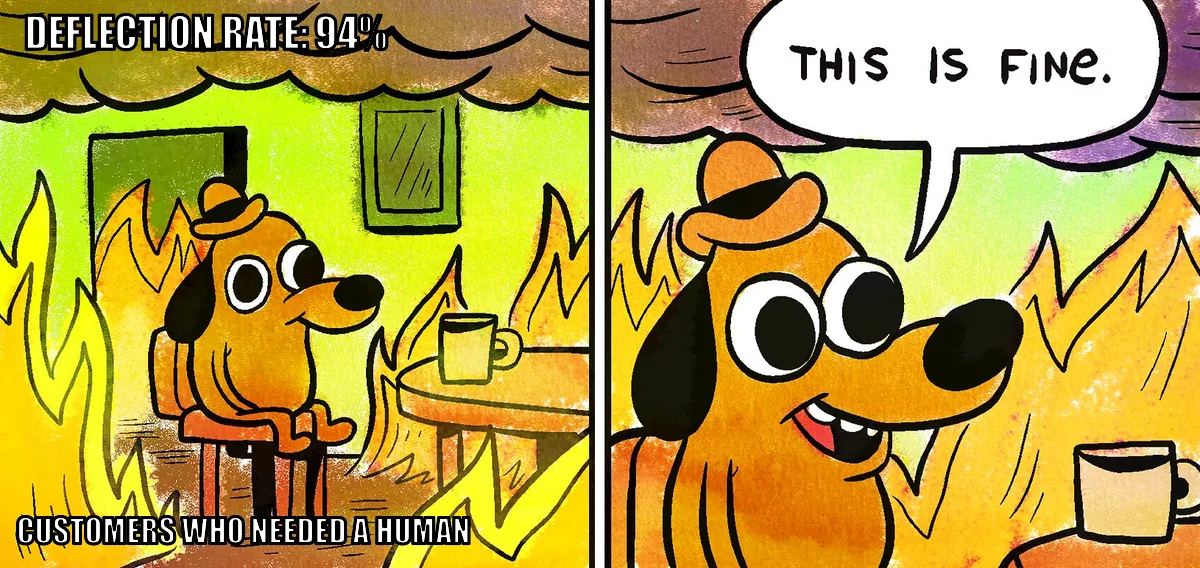
The scoreboard says you’re winning while the value walks out the door.
A complaint isn’t a cost. It’s a fork.
The complaint, the cancellation, the “this didn’t work for me”: those aren’t costs to shave. They are forks, and the classic customer service research, which predates the chatbot era by decades, is blunt about which way they break.
In the complaint handling studies TARP ran for the White House Office of Consumer Affairs in 1979 and 1986, a customer with a small problem who never complained stayed loyal about 37% of the time. One who complained and got a satisfactory resolution stayed around 70%. One whose problem was resolved quickly stayed over 95%. For big ticket problems the gap is wider still: 9% loyalty if they never raised it, 54% if they complained and were satisfied.
Deflection logic gets this backwards. The complaint is not the expensive event. The unresolved complaint is. A complaint handled well is one of the highest return interactions in the business: you keep a customer who was halfway out the door.
And the payoff comes specifically from resolving it well and fast, not from merely closing the ticket. A bot can optimize for closure and speed. It cannot optimize for the goodwill, the judgment call, the save. So a deflected complaint does not capture the 70 to 95%. It captures the close, and gives away the customer.
In plain money: deflecting that complaint saves you a few dollars of an agent’s time. The customer you give away is worth their lifetime value, often hundreds of dollars. You optimized the small number and surrendered the big one.
A complaint that a bot closed but never really resolved is exactly that experience.
Route by value, not by volume
So the goal was never to maximize deflection. It is to route by value. Deflect the genuinely routine without mercy, because there is no win to give away there. On the interactions that carry a real outcome, put a person. Your agents are the asset in that moment, not the cost line a deflection target treats them as. They are the ones who actually save the customer and create the value. The job is not to take those tickets off them, it is to make them great at them: fast and fully informed, so the resolution is both quick and good, which is the combination the research says keeps the customer.
That means changing the scoreboard. “What share of contacts did we avoid” is the wrong question. “What share of high stakes interactions did we win” is the right one. Even a16z, who are the most enthusiastic of AI supporters, note that the deflection rate “doesn’t credit the work” being done, and that the category is overdue for a value based measure. Reichheld’s classic finding still holds: a 5% lift in retention can move profit by 25 to 95%. That swing lives in precisely the interactions a deflection target is built to make disappear.
It is the same split we keep coming back to: deflect what makes sense, and make the half the bot cannot close better than it was before AI. One blended deflection number hides the trade-off, which is why AI in CX is really two products, and only one of them should ever be measured on deflection.
None of this is anti-automation
It is an argument against measuring it wrong. The leverage was never in taking the hard interactions away from your team. It is in helping your team nail them.
You cannot deflect your way to loyalty, because the interactions worth the most are the ones a deflection rate is designed to erase.
Deflect the routine. Win the rest.
Sources
- TARP / John Goodman, Consumer Complaint Handling in America (White House Office of Consumer Affairs, 1979 & 1986; figures restated in Goodman, Strategic Customer Service). Complaint resolution and speed drive repurchase: roughly 37% loyalty for non-complainers on small problems, around 70% when resolved satisfactorily, over 95% when resolved quickly; 9% versus 54% on big ticket problems.
- PwC, Experience is everything (Future of Customer Experience). 32% of consumers would leave a brand they love after one bad experience (survey of roughly 15,000 consumers).
- Reichheld & Sasser, “Zero Defections: Quality Comes to Services,” Harvard Business Review (1990). A 5% increase in customer retention can raise profit by 25 to 95%.
- a16z, “The internet ruined customer service. AI could save it.”. The deflection rate does not credit the work AI is doing; the category is overdue for a value based metric.
Deflection AI is not the problem. It does what it does well. The problem is what happens to the 40 to 50 percent of tickets it cannot close. Those tickets are not the simple ones any more. They are the angry, the nuanced, the brand-defining ones, and they land on a smaller team than before. This pillar covers the economics, the operational reality, and what to do about it.
See the full seriesWhat is Handsom?
AI that investigates every ticket across your stack and resolves it, and your team decides what it handles on its own. The lookup work happens once, by the AI, not on every reply.